
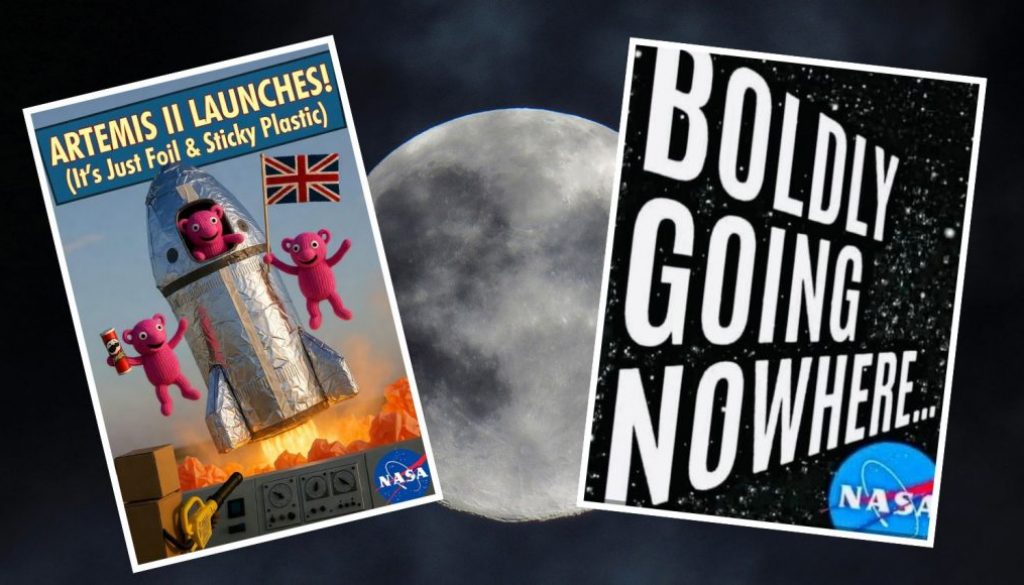
Artemis II “Launches” Amid Revelations It’s Held Together With Sticky-Back Plastic and Aluminium Foil
CAPE CANAVERAL, Florida — In a blaze of carefully positioned fireworks and one enthusiastic intern with a leaf-blower, NASA’s Artemis II rocket “lifted off” this morning, kicking off America’s grand multi-mission plan to return humans to the Moon and “beyond, probably.”
 Officials described the spectacle as “historic,” which, to be fair, it is — the first crewed deep-space flight constructed almost entirely from materials purchased at a closing-down branch of Hobbycraft.
Sources inside the program confirmed what flat-Earthers, tinfoil enthusiasts and several grandmothers have suspected for months: the 322-foot-tall SLS rocket is, in fact, 40% sticky-back plastic, 55% aluminium foil, and 5% hope. The Orion capsule’s heat shield is two layers of BacoFoil and a laminated menu from Nando’s. The solid rocket boosters? Giant Pringles tubes painted white.
“Budget cuts hit harder than we let on,” admitted NASA Administrator Bill Nelson, speaking from behind a cardboard control panel. “We told Congress it was titanium. Turns out Congress believed us.”
As the vehicle reached “max Q” (roughly the speed of a brisk shopping-trolley downhill), four tiny pink figures were seen emerging from the service module. The Clangers — yes, those Clangers — tumbled out, whistling the theme tune and waving a small Union Jack knitted from leftover wool.
Mission commander Reid Wiseman, visible through a porthole clearly made from a repurposed CD case, gave a thumbs-up before the entire stack began gently deflating. Ground control confirmed the crew is “having a lovely time” and will plant the flag somewhere near the swing park on the Moon’s dark side.
Engineers say the return journey will be powered by a single AA battery and the collective national guilt of everyone who believed the 1969 landings were faked.
Next stop: Artemis III, rumoured to be constructed from cereal boxes and optimism.